


From Nurse stations to smart bedsides: what we’re seeing in Singapore, China and Beyond
VITANIA shares on-the-ground insights from Singapore and China’s smart wards, and how AiHui HealthTech’s bedside solutions can bridge both worlds across ASEAN.
BLOG
VITANIA
11/20/20258 min read
If you walk into a hospital ward today, it already feels very different from ten years ago.
Nurses no longer spend most of their time “anchored” at a fixed nurse station. Patients are starting to check their own schedules and results on screens next to the bed. Cameras, sensors and smart beds are quietly watching over things in the background.
At VITANIA, we spend a lot of time in exactly these places – public hospitals in Singapore, innovation centres, and partner hospitals in China. We also work closely with Chinese smart-ward companies such as AiHui HealthTech, and bring them into conversations with Singapore and ASEAN healthcare systems.
This article is our attempt to put into words what we’re seeing:
how Singapore and Western hospitals are redesigning bedside care,
how Chinese “whole-ward” solutions are evolving,
and where companies like AiHui HealthTech can plug into this picture.
1. What’s actually changing at the bedside?
No matter which country we look at, a few things are happening at the same time.
Care is moving to the point of care
More and more documentation, orders and decisions are made right at the bedside or on a mobile device. Nurses and doctors don’t want to walk back and forth just to “type things into the system” anymore.Patients are no longer completely in the dark
In many hospitals, patients can already see their daily plan, upcoming tests, basic results and education content on a bedside tablet or screen. Instead of asking the nurse “when is my scan?” three times a day, they can simply check.The boundary between ward and home is blurring
Virtual wards and home-monitoring programmes are growing quickly. Smart beds, wearables andsensors send data back to the hospital so that part of the “ward” experience happens at home.
These trends are global. But the way they are implemented in Singapore/Western systems and China can feel quite different when you stand in the ward and look around.
2. Singapore and the West: mobility, virtual nursing and patient engagement
Singapore: smart wards as a safe place to try new ideas
In Singapore, “smart wards” are often used as testbeds for new models of care.
At Tan Tock Seng Hospital, the smart ward brings together smart beds, sensors, automation and even robots. The goal is very simple: make life safer and smoother for patients, and make work more sustainable for staff in a system that is always short of manpower.
Patients get a bedside tablet where they can see who is looking after them, what is planned for the day, and sometimes even their vital signs trends or progress.
At Singapore General Hospital and other sites, we see experiments with digital consent at the bedside, tailored education content, two-way messaging and simpler ways for patients to ask for help without always pressing a buzzer and waiting.
Alexandra Hospital goes a step further. Its Smart Ward Ecosystem is closely tied to the idea of an “Alexandra Virtual Hospital”. One of the first use cases there is virtual nursing: a nurse, supported by cameras and smart monitoring, can safely supervise and talk to patients across multiple beds or wards from a central console. In a system where nurses are a scarce resource, this matters a lot.
If we had to summarise Singapore’s approach in one line, it would be: use smart wards to safely try hybrid “physical + virtual” care, then scale what works across clusters.
Western hospitals: from TV above the bed to full engagement platforms
In Europe and North America, the shift often started from something more basic: patient TV and entertainment systems.
Over time, those TV screens and arm-mounted terminals turned into full patient engagement platforms:
Patients watch TV or movies, but they can also see parts of their medical record, education content and their care plan.
Families can join video calls from the bedside.
Hospitals use these tools to collect satisfaction scores, patient-reported outcomes and feedback in real time.
The tone in Western hospitals is often: experience, outcomes, satisfaction, and strict privacy. A lot of engineering work goes into separating the “fun” layer (TV, internet) from the clinical layer (EHR, orders) so that regulations like HIPAA and GDPR are respected.
3. China’s smart wards: whole-ward “operating systems” and where AiHui HealthTech fits in
When we fly back to China and walk into a “智慧病房”, the feeling is different again.
A ward full of screens, but with a clear logic
A typical Chinese smart ward might have:
a large touch screen by each bed,
a nurse-station console with big dashboards,
door-side displays and corridor boards showing who is in which bed, who is on duty, who needs isolation, and so on.
Everything is connected through hospital networks and IoT gateways. Local vendors provide full packages: bedside terminals, nurse-call systems, corridor displays, door lamps, and software that ties everything together.
The result is a very strong sense of “ward as a control room + endpoints”. The nurse station is still an important hub, but much more is visible and manageable at a glance.
For the patient: “almost everything on one screen”
For patients and families in China, the bedside screen is often the main gateway to the hospital:
You can see your test results, upcoming scans, and parts of your care plan.
You can check your bill and sometimes pay from that same interface.
You can order meals, watch TV, read health content, and see information about the hospital.
In some sites you can also control lights, curtains and air-conditioning.
In a few hospitals, smart ward concepts even extend into 5G “home wards”, where monitoring and communication continue at home after discharge.
AiHui HealthTech as an example of this new generation
AiHui HealthTech is one of the companies building this kind of smart ward and bedside ecosystem, and also one of VITANIA’s key partners.
In Chinese hospitals, AiHui tends to deliver three things at the same time:
A bedside experience for patients: one screen that combines information, education, entertainment and service requests.
A smart nursing dashboard for staff: alerts, bed status, tasks and risk indicators in one place.
A set of unattended-care (免陪照护) scenarios: smart mattresses, infusion monitoring, fall-prevention sensors and cameras that reduce the need for family members to sleep on a foldable bed next to the patient.
On top of that, AiHui integrates with infusion pumps, environmental controls and hospital systems so routine checks can be partly automated.
Inside China, the message is: “Let us digitalise the entire ward, from the door to the bed to the nurse station.”
Outside China, the same platform can be made lighter and more modular – and this is where our collaboration starts.
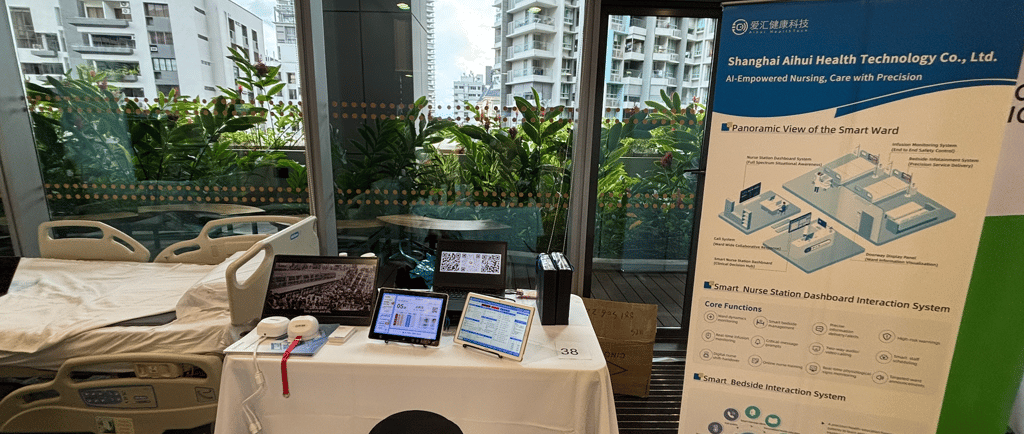
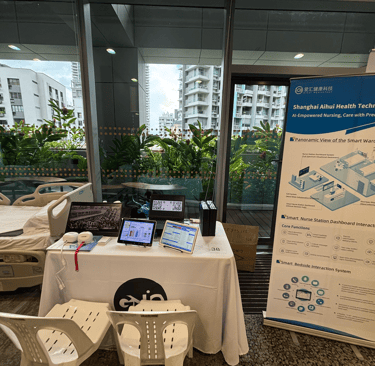
When AiHui joined us at the NHG Health Nursing Innovation Festival 2025 in Singapore, the conversations naturally moved towards questions like:
Which parts of the solution make immediate sense for Singapore and ASEAN?
Where do we need to start small? for example, just with bedside tablets and dashboards?
How do we design around local privacy rules and IT realities?
4. Different philosophies, same goal
If you look only at the hardware, Singapore/Western hospitals and Chinese hospitals might seem to be doing similar things: screens, tablets, dashboards.
But in practice, there are two different “mental models”.
Where work happens
In Singapore and the West, nurse stations are still there, but more and more work happens on the move, on mobile devices, at the bedside, and on virtual nursing consoles. The station becomes a lighter “coordination hub”.
In China, the nurse station remains a strong “command centre”, tightly connected with corridor screens, door displays and nurse boards. The architecture feels closer to “control room + many terminals”.
What “patient-centred” means in daily life
In Singapore and Western hospitals, “patient-centred” usually means shared decisions and self-management. Bedside systems are used to make care plans transparent, collect patient-reported data and support virtual consults.
In China, “patient-centred” often shows up as end-to-end convenience: one screen that solves information, payment, services and even room comfort, while still improving clinical transparency.
AiHui HealthTech sits in the middle of these two worlds. In China, it shows how far integrated ward-level orchestration can go. Through its work with us in Singapore and ASEAN, it is learning how to re-frame these capabilities as:
safer care with fewer missed events,
less physical burden on nurses,
and smoother hybrid “onsite + remote” workflows.
And of course: regulation and business models
Singapore and Western markets demand very careful privacy, cybersecurity and integration work. You cannot just “add a screen” without thinking about where the data flows and who has access to what.
China, on the other hand, places strong emphasis on data localisation and domestic technology stacks. That pushes vendors to build full-stack platforms and gives them experience in strict data governance from day one.
For companies like AiHui, this means they already know how to operate under tight rules – they “just” need to speak the local language of each health system, both technically and culturally. That “translation” work is a big part of what we do at VITANIA.
5. How we at VITANIA approach cross-border smart wards
When we work with Chinese smart-ward companies and ASEAN hospitals, we usually start with a few very practical questions:
Where is the natural starting point?
For some hospitals, that might be simple bedside tablets with a limited set of functions. For others, it could be smart nursing dashboards or specific unattended-care scenarios.How do we integrate with what already exists?
In Singapore, cluster-wide IT platforms and virtual-ward initiatives are already in motion. Any new solution has to fit into that picture, not sit on the side as an island.What problem are we solving first?
Saving nurse time? Reducing falls? Improving night-time safety? Giving families peace of mind? Or preparing for hospital-at-home?
Our role is to help both sides answer these questions honestly, and then design step-by-step pilots that are safe, measurable and realistic.
We believe the most successful smart-ward collaborations in the coming years will:
use China’s strengths in full-stack hardware-plus-platform,
combine them with Singapore and Western experience in virtual nursing and patient engagement,
and stay very close to what patients and nurses actually need on the ward floor, not just what looks good in a brochure.
VITANIA will continue to act as a bridge in this space, for companies like AiHui HealthTech, and for hospitals across Singapore and ASEAN that are ready to re-imagine life at the bedside.
Reference Sources
Tan Tock Seng Hospital – Smart Ward (Ward 5C)
Tan Tock Seng Hospital. “Smart Wards – Leveraging AI, Automation and Technology to Bring Better Care.” Official TTSH website, 2023. Describes Ward 5C as a sandbox for inpatient innovation, including smart beds, robots and predictive sensors.Alexandra Hospital – Smart Ward Ecosystem & Virtual Hospital
Alexandra Hospital. “We are Redesigning Healthcare” & “Medtech marvels usher in a new era of healthcare.” Alexandra Hospital / SingHealth & media coverage, 2023–2024. Introduces the Smart Ward Ecosystem, virtual nursing model and plans for the Alexandra Virtual Hospital.Singapore Virtual Hospital Wards (MIC@Home Pilot)
Synapxe. “Virtual hospital wards to be scaled up across three clusters as part of Ministry of Health endorsed pilot.” Media release, 29 Sept 2022. Outlines the Mobile Inpatient Care @ Home sandbox and cluster-wide virtual ward strategy.Mahkota Medical Centre – Malaysia’s First Next-Gen Smart Ward
Mahkota Medical Centre / HMI Group and partners. Articles and media coverage on “Malaysia’s First Next-Gen Smart Ward,” 2024–2025. Describe bedside tablets, e-paper displays, real-time monitoring and workflow benefits in Mahkota’s smart ward implementation.Oneview & Bedside Patient Engagement Platforms
Oneview Healthcare & Hillrom / Care Communications. Product pages and blogs on the Oneview Care Experience Platform and inpatient virtual care, describing EHR-integrated bedside terminals for entertainment, education, meal ordering and virtual interactions.Guangdong Second Provincial General Hospital – 5G Smart Home Ward
Cheng W. et al. “An Introduction to Smart Home Ward–Based Hospital-at-Home Care in China.” Digital Health / PubMed Central, 2024, and related Huawei smart hospital case studies. Describe the 5G-powered Smart Home Ward extending ward-level monitoring and care to patients’ homes.OpenHarmony-based Smart Ward in Chongqing Liangjiang New Area People’s Hospital
Global Intelligent Internet of Things Consortium (GIIC) & CEIC. News on “Southwest China’s First OpenHarmony Ward Benchmark,” 2025. Introduces an OpenHarmony-based nurse call and smart ward system deployed across all wards in the new hospital district.ETR IoT Smart Ward Nursing System
ETR Group / ETR Medical. Product descriptions and solution briefs on the “IoT Smart Ward Nursing System,” describing nurse call hosts, bed extensions, corridor displays, door lamps, bedside screen payment and automated data upload in ward environments.Lachesis Smart Ward Solution & Interactive Platform
Shenzhen Lachesis Mhealth Co., Ltd. “Smart Ward Solution” and “Smart ward interaction platform” product pages. Present an integrated ward platform connecting multiple hospital information systems, IoT devices and barcoding to support closed-loop nursing quality management.Additional Context on Smart Hospitals and Intelligent Wards in China
Selected academic and industry publications on intelligent hospitals and ward-level digital twins, 5G smart hospitals and AI-enabled hospital management in China, used for general background on national trends in smart hospital construction.
✉️ Email Address:
📍Singapore Headquarters:
14, Robinson Road, #08-01A
Far East Finance Building
Singapore 048545
📍United Kingdom Office:
71–75 Shelton Street
London, WC2H 9JQ
United Kingdom